


1900s

Hi guys, here we are in the 20th Century! In our previous posts you can see we mostly talked about a period of a century. Now, because of all these new technologies, everything is changing really fast! So, we will post about every decade.
The 1900s is the time of Art nouveau - a movement in art and architecture - with swirling and organic shapes, a return to nature. (check out the great illustrator Mucha!).
It is also the time of the modern world as we know it. Because of the invention of electricity, everything changes with new inventions, like the first car!, airplanes!, phones,... And it is the time of the hourglass, in terms of fashion...
The ideal body type of women was elegant, tall, long neck, full bosom, full hips and a tiny waist. They achieved this with extreme corsetry. Every lady forced herself into restrictive, boned s-curved corsets, which pulled waists (and a woman’s digestive organs!) into tiny circlets. The sale of smelling salts certainly did well during this era!
We also saw the first photoshopping: advertisements of this beauty ideal of super-tiny unnatural waists! To achieving this ideal, some of these woman probably swallowed tapeworms to get thinner.

The perfect beauty ideal of that time was like 'the Gibson Girl' - an iconic representation of the beautiful and independent woman (a creation of Charles Dana Gibson, an American illustrator). This woman had smoothy and heavy eyes, with a hairdo like a cottage loaf bread.
The dominant fashion idea was a large-adorned hat (Cart Wheel hat), a long equally adorned dress with a cinched waist. The more stuff or embellishments you had on, the more fashionable you were. You can also see the influences of Art Nouveau, with a lot of swirling and organic shapes in their hairdos, fabrics, etc..
They had different dresses for every occasion. Women changed their clothes even a couples of times a day. Their wardrobe existed of lingeries, morning gowns, afternoon gowns, walking dresses, cycling combinations, costumes for traveling in a train or a motor car, evening gowns to lounge, a gown each for a special occasion, like Ascot, a wedding, theatre,... A list as endless as your purse allowed!
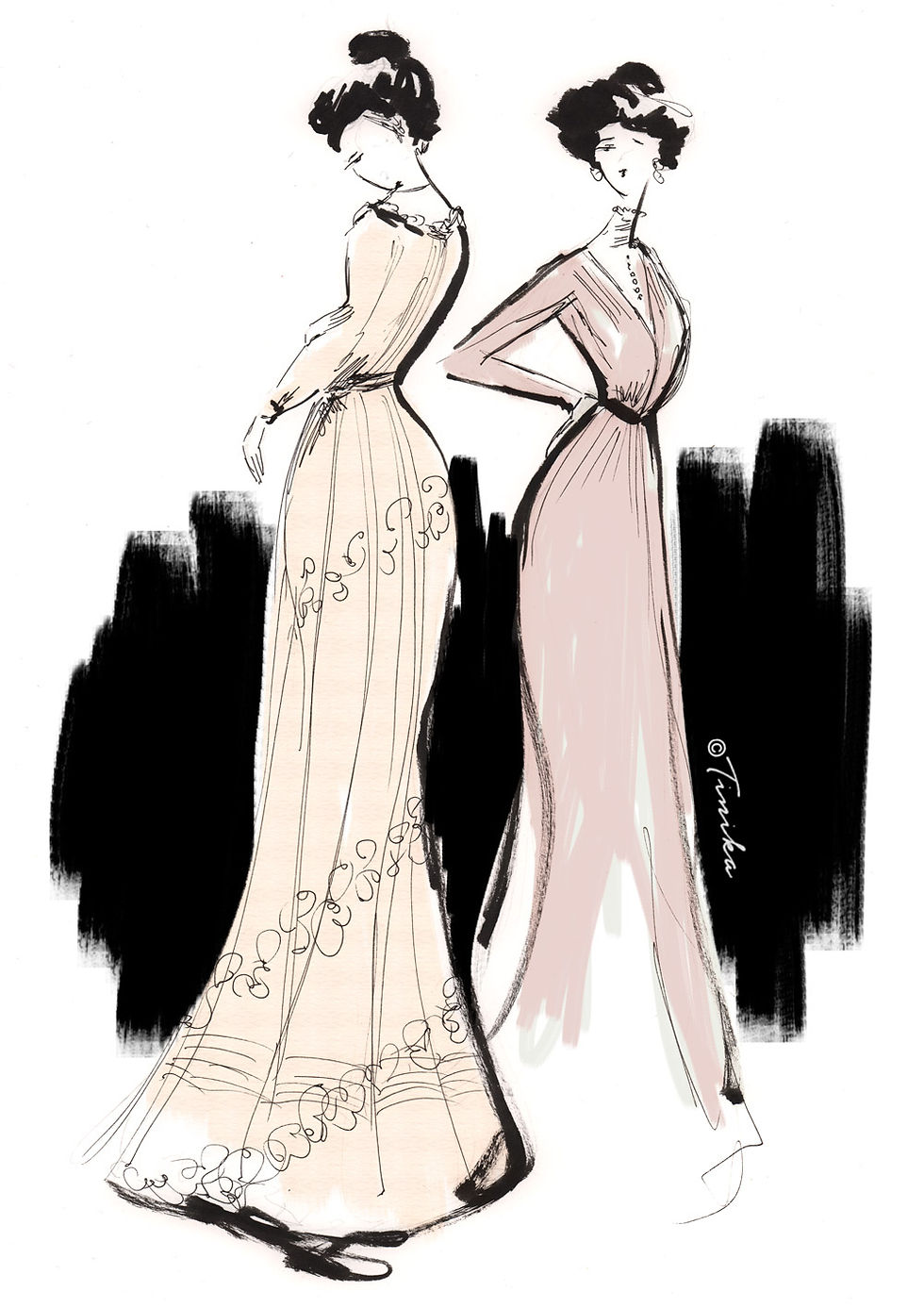
The Palette was soft and feminine, (lilac, rose, pink, dusty, ivory or soft pastel colors).
Parasols were 'the' accessory for fashionable ladies. They didn't used it for protection of the sun, but to help their balance when they walked!
'The Skirt waist' was a typical basic blouse of that period. Every woman wore it, with a long heavy skirt. It was also the start of the separates - skirt, shirt & jacket.
From the early 1900s till 1910s the silhouette moved slowly along a decreasing s-curve to the Empire line. Woman began to wear 'the safety corset', because it was 'better for your organs'
Check out Margo's beautiful drawings! I really love her style!

Sources
Book : fashion design 1800-1940 (The Pepin Press)
Book : Fashion - Volume I + II (Taschen)


keonhacai mình thấy bạn bè nói hoài nên tiện tay vào xem thử cho biết. Vào trang cái là thấy bố cục chia mảng khá rõ, nhìn lướt qua vẫn biết chỗ nào là phần thông tin chính, chỗ nào là thanh điều hướng. Mình không ngồi đọc kỹ từng mục, chủ yếu xem trải nghiệm dùng có dễ không thôi. Điểm mình ưng là menu đặt ngay chỗ dễ nhìn, bấm qua lại nhanh, không phải mò mẫm nhiều. Mấy khung bảng thông tin cũng canh hàng cột gọn gàng, chữ thoáng nên đỡ mỏi mắt khi lướt trên điện thoại. Nói chung cảm giác nhẹ nhàng, không bị nhồi quá nhiều thứ một lúc. Mình thích nhất là…